
Signal and Information Processing Lab
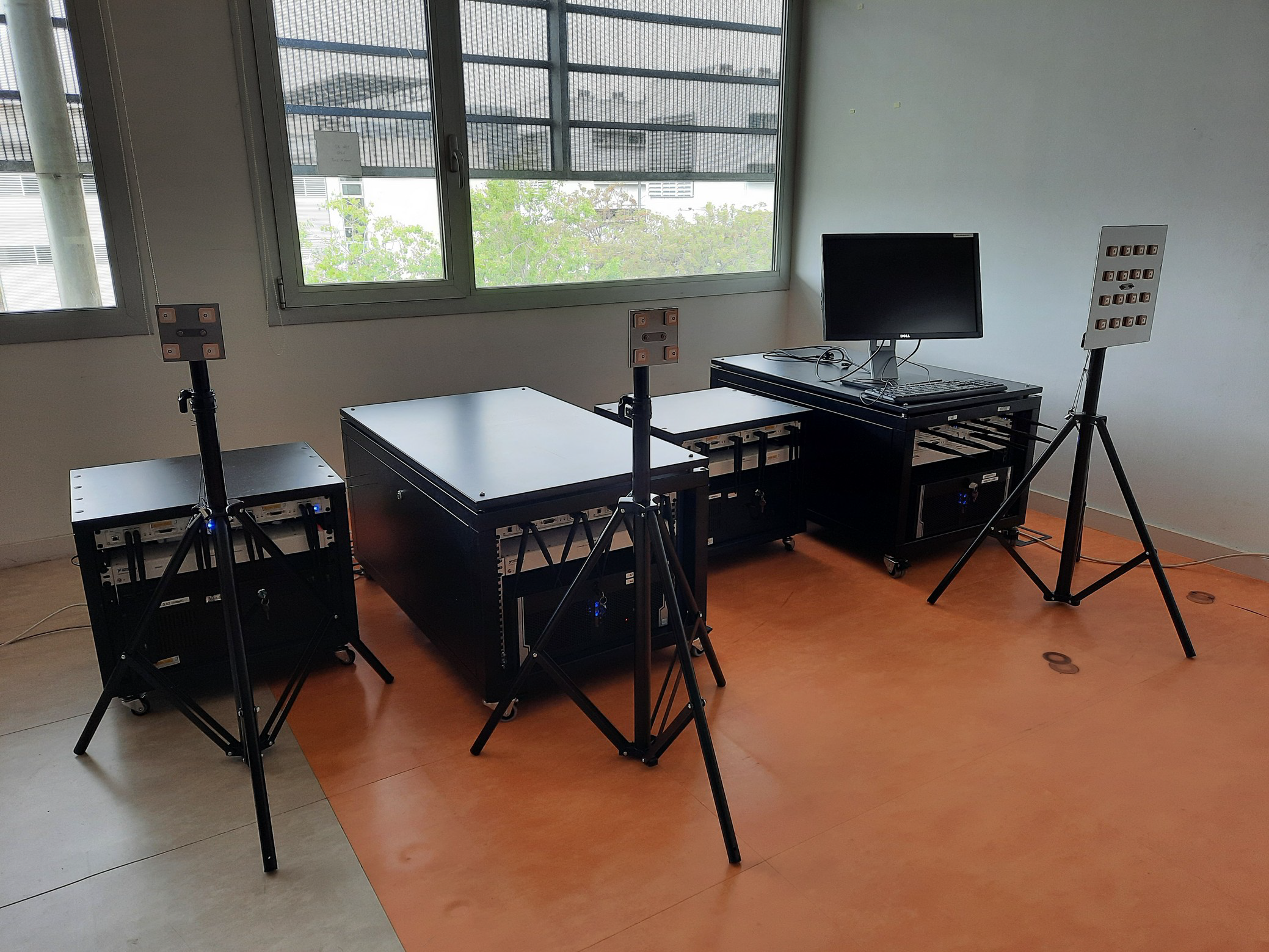
Over-the-air testing of communication sytems
AI/ML aided communication algorithms
Proofs-of-concept of 5G/6G schemes
Multi-user and multi-antenna settings
GPU-aided computations
The CTTC Indoor Navigation Lab is a space dedicated to the development, testing and measurement of positioning and navigation solutions. It has been developed in a joint effort by several CTTC Research Units, partly funded by the ERDF under the 5GLab project. The laboratory consists of a space dedicated to tests and measurements with marked vinyl flooring that facilitates the visual location and positioning of equipment, objectives, etc. The ground features a checkerboard pattern with a cell size of 20 cm. It also includes benchmarks that have been referenced with high precision by a total station during the calibration and configuration phase. Ground reference locations are complemented by wall and ceiling locations that can be used to house anchors during measurement and testing campaigns. In particular, the laboratory is equipped with various sets of UWB anchors, target nodes and development kit, lidar and ultrasonic sensors, as well as an optical headlight system. Radar equipment is also available, including a 24 GHz (K-band) FMCW radar development kit and a Software Defined Radio (SDR) development platform for the development of new 6 GHz (C-band) radar systems. Additional equipment includes a set of ITEE-G5 compatible IEEE 802.11p OBUs.
Indoor Navigation Lab
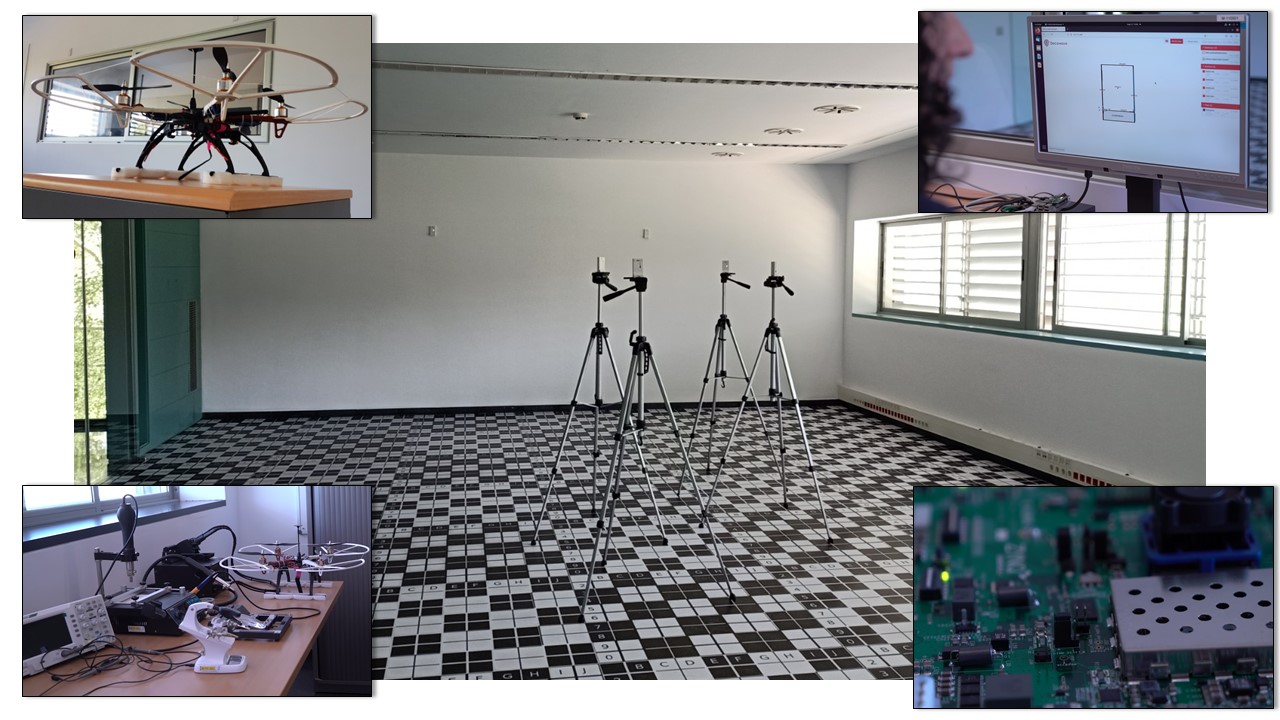
The CTTC Indoor Navigation Lab is a space dedicated to the development, testing and measurement of positioning and navigation solutions. It has been developed in a joint effort by several CTTC Research Units, partly funded by the ERDF under the 5GLab project. The laboratory consists of a space dedicated to tests and measurements with marked vinyl flooring that facilitates the visual location and positioning of equipment, objectives, etc. The ground features a checkerboard pattern with a cell size of 20 cm. It also includes benchmarks that have been referenced with high precision by a total station during the calibration and configuration phase. Ground reference locations are complemented by wall and ceiling locations that can be used to house anchors during measurement and testing campaigns. In particular, the laboratory is equipped with various sets of UWB anchors, target nodes and development kit, lidar and ultrasonic sensors, as well as an optical headlight system. Radar equipment is also available, including a 24 GHz (K-band) FMCW radar development kit and a Software Defined Radio (SDR) development platform for the development of new 6 GHz (C-band) radar systems. Additional equipment includes a set of ITEE-G5 compatible IEEE 802.11p OBUs.